
.svg)
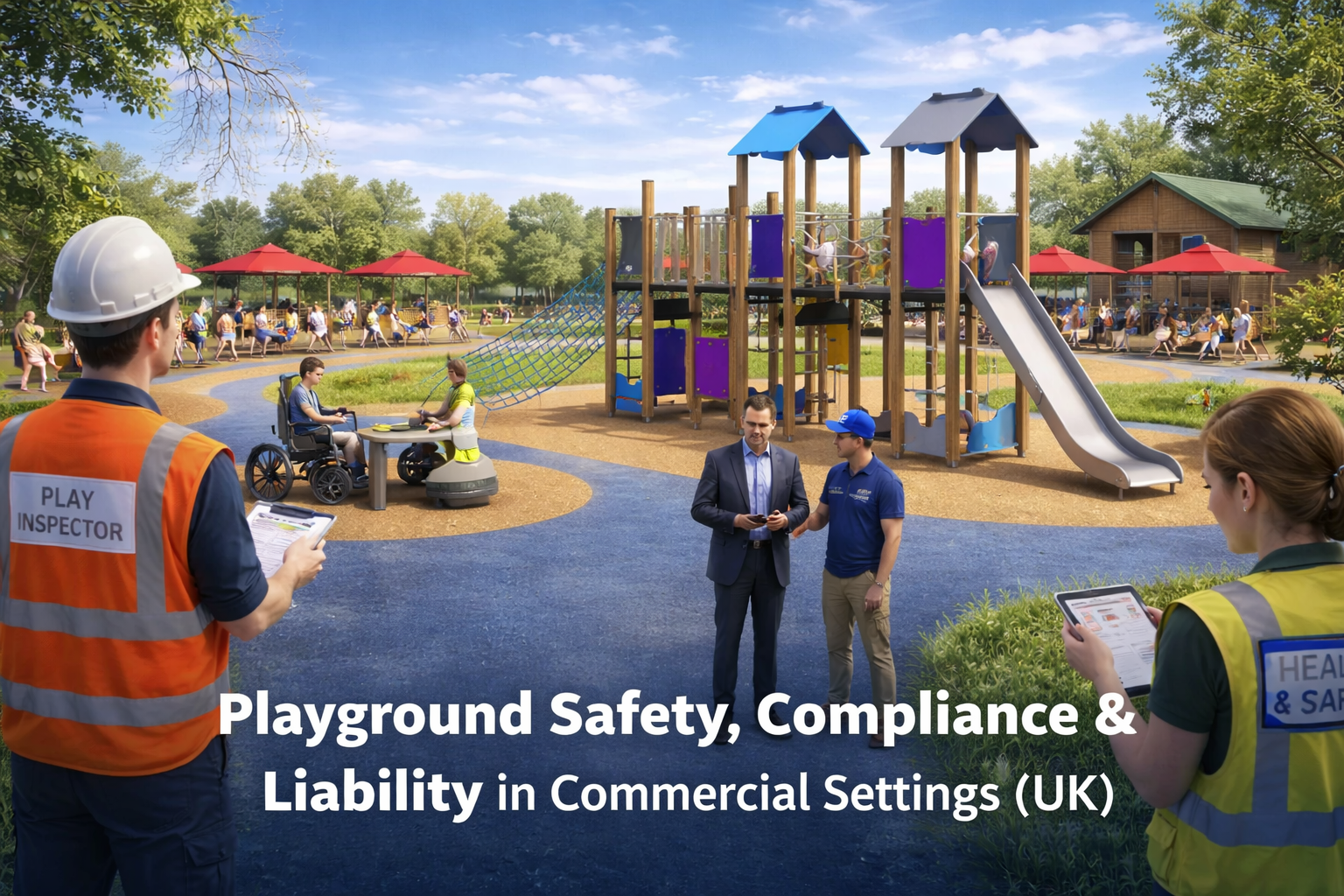


Playground Safety, Compliance & Liability in Commercial Settings (UK)
Playground safety and compliance are critical considerations for commercial leisure environments. Unlike school or council playgrounds, commercial play spaces operate in high-footfall, public-facing settings where liability, insurance and reputational risk must be carefully managed.
For holiday parks, visitor attractions, leisure venues and commercial operators, playground safety is not just about meeting standards — it’s about protecting visitors, staff and the long-term viability of the business.
This guide explains how safety, compliance and liability are managed in commercial playground settings across the UK, and what operators need to consider when planning or upgrading a play space.
Understanding Safety Responsibilities in Commercial Playgrounds
Commercial playground operators hold a duty of care to all users of their site. This responsibility applies regardless of whether access is ticketed, free, supervised or unsupervised.
In commercial settings, operators are typically responsible for:
- Providing safe, compliant play equipment
- Ensuring appropriate surfacing and layouts
- Carrying out regular inspections and maintenance
- Managing foreseeable risks
- Maintaining accurate inspection and maintenance records
Clear understanding of these responsibilities is essential for protecting both users and the operator.
For wider public-sector comparisons, some operators may also find Councils & Local Authority Playground Equipment useful.
EN 1176 Playground Safety Standards
All professionally installed commercial playground equipment in the UK must comply with EN 1176 playground safety standards. These standards apply equally to leisure parks, attractions and visitor destinations.
EN 1176 governs areas including:
- Maximum fall heights and safety zones
- Equipment spacing and layout
- Entrapment and entanglement prevention
- Structural integrity and fixings
- Access and egress design
Compliance with EN 1176 is fundamental to managing risk, supporting insurance requirements and demonstrating professional duty of care.
For broader technical context, see outdoor play safety and compliance.
Risk Management vs Risk Elimination
Modern playground safety is based on risk–benefit assessment, not the removal of all challenge.
In commercial settings, this approach recognises that:
- Some level of challenge supports child development
- Overly restrictive design reduces play value
- Unmanaged hazards must still be eliminated
Effective commercial playground design balances:
- Physical challenge
- Clear, foreseeable risk
- Appropriate fall protection
- Logical layouts and circulation
This balance allows children to explore and engage safely while protecting operators from avoidable liability.
Playground Surfacing & Fall Protection
Surfacing is one of the most important safety considerations in commercial playgrounds, particularly in high-use environments.
Common surfacing systems include:
- Wetpour rubber surfacing
- Rubber tiles
- Bonded rubber mulch
- Engineered wood fibre
- Grass matting systems
Surfacing selection must align with:
- Equipment fall heights
- Expected usage levels
- Drainage and weather exposure
- Maintenance capacity
Well-chosen surfacing significantly reduces injury risk and supports long-term compliance.
For mixed-use environments, see outdoor play equipment.
Inspection & Maintenance Requirements
Commercial playgrounds require structured inspection and maintenance regimes to remain safe and compliant.
Typical inspection frameworks include:
- Routine visual inspections
- Operational inspections at regular intervals
- Annual independent inspections
- Scheduled surfacing performance checks
Clear documentation of inspections and remedial actions is essential for insurance and liability protection.
Long-term operational planning is explored further in playground maintenance & lifecycle costs for commercial operators.
Liability, Insurance & Documentation
In commercial leisure environments, playground safety is closely tied to insurance and liability management.
Operators should ensure:
- Equipment is EN 1176 compliant
- Inspections are recorded and retained
- Maintenance actions are documented
- Modifications are professionally assessed
- Staff understand basic safety reporting procedures
Clear documentation demonstrates proactive risk management and significantly reduces exposure in the event of incidents or claims.
Inclusive Safety in Commercial Play Spaces
Inclusive and accessible play introduces additional safety considerations, particularly where shared-use equipment is specified.
Inclusive safety planning may include:
- Wider safety zones around shared-use equipment
- Step-free access routes
- Transfer-accessible features
- Clear visual contrast and orientation cues
For specialist guidance, operators may wish to explore:
Inclusive safety planning ensures accessibility enhances play rather than introducing unmanaged risk.
Why Safety & Compliance Matter Commercially
Effective playground safety management delivers more than compliance — it protects commercial performance.
Strong safety planning:
- Reduces accident risk and claims
- Supports insurance confidence
- Protects brand reputation
- Minimises downtime and closures
- Builds trust with visitors and families
In competitive leisure markets, visible professionalism and safety competence are significant differentiators.
Working with Commercial Playground Safety Specialists
Designing and managing safe commercial playgrounds requires experience beyond standard playground provision. Professional support ensures safety, compliance and operational realities are considered from the outset.
At Morti Sport & Play, we work with commercial operators across the UK to deliver compliant, durable and well-managed play environments for leisure and visitor destinations.
👉 Speak to Morti Sport & Play about commercial playground safety and compliance


