
.svg)
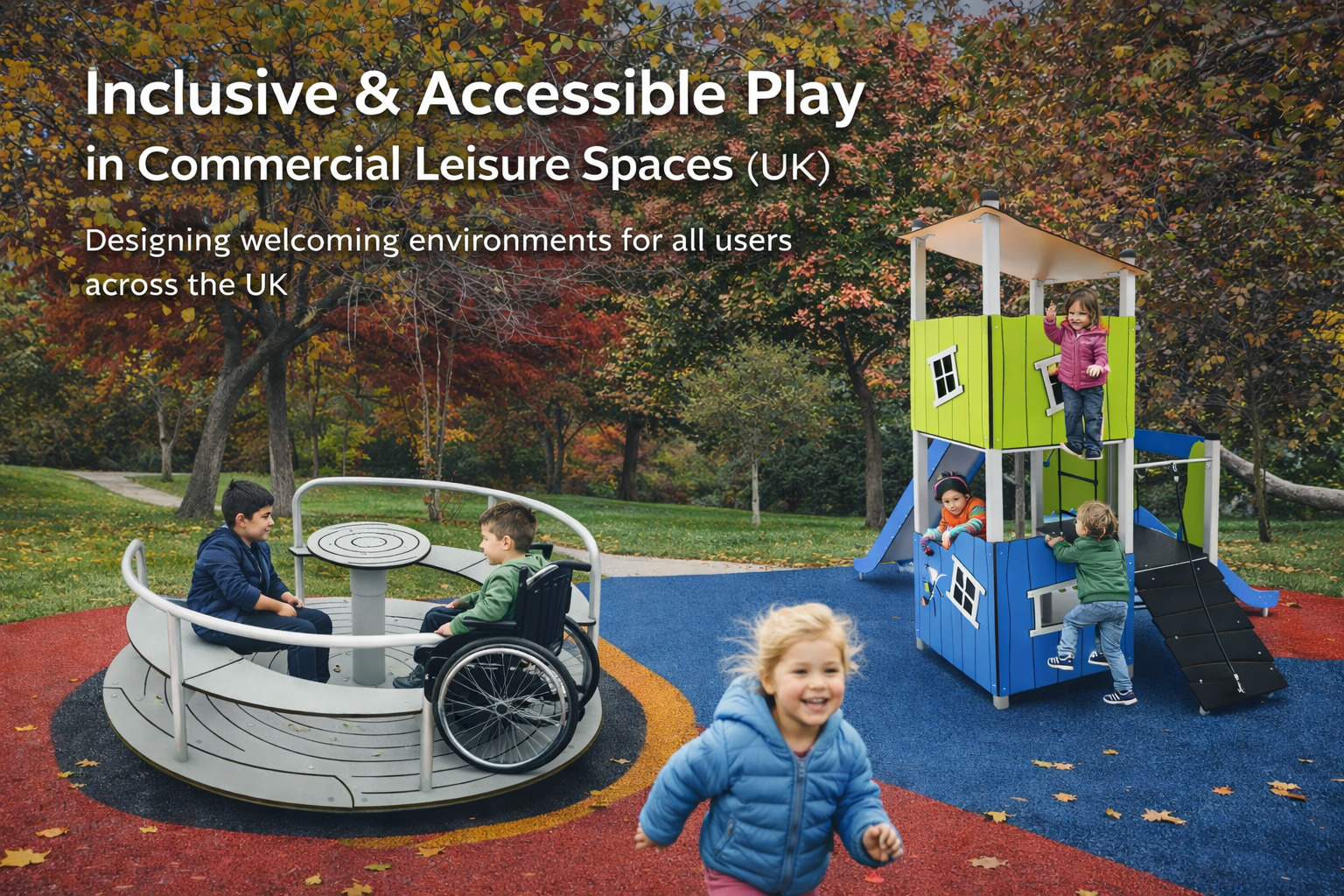


Inclusive and accessible play is no longer a “nice to have” in commercial leisure environments. For operators of holiday parks, attractions, visitor centres and mixed-use leisure destinations, inclusive playgrounds play a direct role in visitor satisfaction, dwell time and brand reputation.
Unlike education or council-led playgrounds, commercial leisure spaces must balance inclusive access, play value and commercial performance. This guide explains how inclusive play works in commercial settings, why it matters, and how operators can design environments that are welcoming, compliant and commercially successful.
For a wider overview of leisure-led environments, see commercial & leisure play spaces.
What Inclusive Play Means in Commercial Settings
Inclusive play goes beyond physical access. In commercial leisure environments, inclusion focuses on shared experiences, allowing children of different abilities to play together rather than separately.
Inclusive commercial playgrounds typically support:
- Mixed-ability group play
- Multiple ways to access and experience equipment
- Clear, intuitive layouts for families and carers
- Equipment that appeals to a wide age range
This approach improves overall visitor experience while supporting accessibility expectations.
Inclusive vs Accessible: Understanding the Difference
Accessibility ensures that children with physical disabilities can reach and use play equipment. Inclusion ensures that children of all abilities can play together.
Commercial playgrounds should aim to deliver both by combining:
- Step-free routes and accessible surfacing
- Ground-level and transfer-access equipment
- Sensory, movement-based and social play features
- Equipment that does not isolate users by ability
For deeper guidance, see inclusive playground equipment.
Why Inclusion Matters for Commercial Operators
Inclusive play delivers tangible commercial benefits, including:
- Increased visitor dwell time
- Broader family appeal
- Positive brand perception
- Reduced complaints and reputational risk
- Alignment with accessibility expectations
Families increasingly choose destinations that are welcoming to all children, making inclusive play a competitive advantage in leisure markets.
Designing Inclusive Commercial Play Spaces
Effective inclusive design starts at the planning stage.
Commercial inclusive playgrounds often include:
- Shared-use roundabouts and swings
- Ground-level play panels and sensory features
- Graduated challenge climbing elements
- Social seating and gathering points
Layouts are designed to support supervision, circulation and shared use, ensuring that inclusion enhances — rather than restricts — play value.
For public-sector approaches, see councils & local authority playground equipment.
Accessibility & Compliance Considerations
Commercial operators remain responsible for safety and compliance across all users.
Inclusive playgrounds must meet:
- EN 1176 playground safety standards
- Appropriate surfacing and fall zones
- Clear access routes and sightlines
- Safe spacing between equipment
For compliance planning, see playground safety and compliance in commercial settings.
SEN & Disability Considerations in Leisure Play
Many commercial playgrounds serve children with additional needs, even when not explicitly designed as SEN facilities.
Inclusive commercial play design may include:
- Calm sensory elements
- Predictable movement features
- Quiet retreat areas
- Equipment usable with or without assistance
Where inclusion is a priority, operators may also wish to explore SEN & Inclusive Playground Equipment and Disability Playground Equipment for specialist solutions that integrate into shared leisure environments.
Maintaining Inclusive Play Over Time
Inclusive play environments require ongoing attention to ensure continued accessibility and usability.
Key considerations include:
- Regular surfacing checks
- Maintaining access routes
- Monitoring wear on shared equipment
- Keeping sensory features functional
For long-term planning, see playground maintenance and lifecycle costs for commercial operators.
Inclusive Play as a Commercial Asset
Inclusive playgrounds are not just a compliance exercise — they are a strategic asset.
Well-designed inclusive leisure playgrounds:
- Encourage repeat visits
- Improve family satisfaction
- Support longer stays
- Strengthen destination reputation
When inclusion is embedded into the overall leisure experience, it delivers both social and commercial value.


